
Encyclopaedia of Book Printing
Help for book designers and self-publishers.Select ALL in the alpha index and then search this page for print terms.
– A –
A Sizes
The trimmed sizes (finished size as it appears in the book) based on the International Page Sizes range. Examples are A5 and A6 trimmed sizes.
Acid-free Paper
A form of Art Paper with a pH rating of over 7. The life expectancy of acid-free paper is a lot higher because acid causes the cellulose fibres contained in paper to break down. The book’s pages will appear brittle and show yellowing and cracking.
Acrobat
Produced by software company Adobe, Acrobat is patented technology that facilitates documents (containing both text and Images) to be created on one computer system and transferred to another. The common form of these files is PDF. A PDF is essentially a portable document format that can be ported or transferred elsewhere without any change to the intended format or corruption of the intended format.
Adhesive Binding
Glue is applied to the spine of the book – one edge of the book block – often roughened to improve grip. Glue can either be hot-melt or cold. If the book block is ground/scored this can result in the book block losing 1-3mm of its size along one edge. Polyurethane Reactive adhesive (PUR) binding is a popular method of binding paperback books. In addition to PUR, books can be bound by using lower cost EVA (hot-melt) glue. PUR adhesive is more flexible meaning the book can be opened flatter.
Aliasing and Anti-Aliasing
Where an image or text can be seen as jagged or has pixel steps. This happens when an image is enlarged beyond its raw resolution. Low resolution files can use anti-aliasing e.g. in software such as Adobe Photoshop – a process where the steps in the image can be corrected by introducing modified colours between the steps.
Antique
A paper that has not been rolled smooth or undergone any calendering.
Artwork
Illustration, drawings, photographs, maps or and decorations intended for the printed page. Artwork can also mean the design files for a book including the cover and interior.
Art Paper
A coated paper used mainly for illustrated books, photo sections, and colour inserts. It is a high quality coated printing paper with smooth surface. The reproduction of fine multicolour pictures “art on paper”, requires a paper that has a closed surface and a uniform ink absorption.
Produces sharp images and rich colour but is heavier than standard text paper.
Author’s Alterations
Corrections made by the author during any stage of the proofing process of a book. Author’s alterations are charged back to the author i.e. implemented at additional cost.
Author’s Proofs
Sometimes author’s proofs are referred to as printer’s proofs.
A proof or evidence of likely print quality given to the author of the book before printing the book in volume is undertaken. These are in the form of a book format generated from the electronic artwork provided, that can be in electronic format e.g. a PDF file or a printed hardcopy.
– B –
B Paper Sizes
B paper sizes (ISO 216 B series) are larger alternatives to the A paper size series. B sizes are commonly used for posters, books, and passports, whereas the A series is more office-focused. The B series maintains the same 1:1.414 aspect ratio, with B0 starting at 1000 × 1414 mm and each subsequent size halving one dimension. Key sizes include B1 (707×1000mm), B2 (500×707mm), B4 (250×353mm), and B5 (176×250mm).
Backing-up
Printing the reverse side of a page after the first side has been printed. This involves aligning the reverse side of the paper of a previously printed sheet to match the type area.
Bible Paper
A very light weight paper used to print Bibles, dictionaries or encyclopaedias. Although it is extremely thin it has high opacity helping to reduce print show through (from one side to the other). Bible paper ensures that the book isn’t unwieldy – too large or heavy thus improving reader usability.
Binding
Binding refers to the various methods of fastening printed pages or sections together once printed, usually to be encased in a protective cover. The main binding styles are paper binding for ‘paperback’ or ‘softcover books’, and case binding for ‘hardcover’ or ‘hardback’ publications. Saddle-stitching is another commonly used method to enable a publication to lay flat. Page creep and gutter loss are a couple of the factors to be considered when choosing a binding style.
Bleed
The printed area that extends beyond the trim size so colour reaches the edge after trimming. Typically a minimum of 3 mm is required. The bleed makes sure any mis-cuts in the trimming process do not show unprinted areas which can look unsightly.
Block / Blocking
Metal dies used for foil stamping or embossing on book covers.
Board
Very heavy paperboard used for hardback covers. Boards come in many types including but not limited to:
- Binder’s – which is made from a solid sheet of fibre and not prone to warping.
- Bristol – high-quality cardboard made rigid by gluing two or more sheets together
- Chip – lower quality board made form mechanical wood pulp, ground wood or other waster materials
- Ivory – high-grade board made by laminating layers of identical quality sheets
Boards are commonly wood based and are commonly 2mm thick.
Book Block
The gathered pages or sections/signatures of a book before the cover – paperback or case – is attached.
Book Paper
Paper specifically designed for book interiors, balancing opacity, weight, flexibility, and readability.
Brightness
How much light a paper reflects. Brightness is measured by blue light reflected by the page. Higher brightness gives cleaner whites and stronger contrast but can be harsher on the eyes. Often a crème paper is used for novels because it is less bright and easier on the eye. It can be adjusted by variations to the chemical mix of the paper. Brightness is expressed as a percentage.
Buckram
Buckram is a very durable, stiff, sturdy woven fabric, traditionally made from cotton or linen that is stiffened with starch, glue or resin. It is mainly used in the binding of legal and library or reference books.
Bulk
Bulk is a term used to describe the thickness of paper stock. The bulk of a book is determined by the bulk of the paper, along with the total number of pages. Bulk needs to be considered for the size, weight, binding, and handling of a book.
Bull’s Eye
A bull’s-eye or hickey is an accidental printing defect normally caused by dust or lint. It can manifest as a white spot on a coloured background, or as a smudge.
Burst (Notch) Binding
Burst, or notch, binding provides strong binding for coated pages without sewing. This method involves the gouging of grooves into the spine of the book block which allows for deeper penetration of adhesive. It can be used when perfect binding a book.
– C –
Calendered Paper
Paper passed through a stack of steel rollers to improve smoothness and print clarity. Calendered paper has a range of paper smoothness from a less smooth Antique to Smooth, depending on the number of rollers the paper passes through. This process happens right at the end of the paper making process when the paper is dry or almost finished.
Case Binding (Hardcover)
A binding method where the book block is attached to a rigid cover. Used for hardback books. The Case is the cover of the book and can be composed of cloth, paper or synthetic material (or a combination of these) stretched over and adhered to a board. Case-binding is a task for a specialist, is relatively slow and much more expensive than perfect binding especially if printing in Australia. Used for coffee-table books and cookbooks, case bound books often employ section-sewn interior pages which allows them to remain open with a high degree of ‘flatness’.
PUBLISHING TIP Designing a case-bound book cover is more complex than designing a cover for a perfect bound book. The cover is often printed on thin paper and then wrapped around a thick board e.g. a 2mm board – then a endpaper is applied. The artwork must extend well beyond the usual 3mm bleed required for a softcover book.
Cast Coated Paper
High-gloss coated paper with a polished finish, often used for premium book covers or dust jackets. These are made by drying the heated coating with a chrome surfaced drum.
Chemical Wood Pulp
Wood fibres are held together by organic polymers called lignin. Chemicals can be used to break down these fibres, leaving cellulose material which is used in the production of higher grades of paper. Chemical wood pulp may also be mixed with mechanical pulps to improve the quality.
Chinese New Year (CNY)
Chinese New Year is the spring festival marking a 15 day lunar festival starting with the new moon. It occurs each year within the dates January 21 and February 20 each year. You can check the date of this year’s festival: Chinese New Year Dates It is a time of celebration with many Chinse people celebrating with family. This means that Chinese print companies shut down within this period and print projects will go on hold. Information about the timeline of a print project out of China can be found here: China print timeline
CMYK (Process Colour)
Abbreviation for the four inks—cyan, magenta, yellow, and black—used for full-colour book printing.
Coated Paper
Paper with a treated surface – a fine clay coating – that improves image sharpness and ink control. Common for covers and illustrated books. The clay coating is polished to provide papers with varying degrees of sheen from low to high:
- Matt
- Satin
- Silk
- Gloss
Cold Melt
Cold melt is a binding adhesive primarily composed of natural or synthetic polymers dispersed in water, that does not require heat to melt. The cold melt glues most commonly used in printing are PUR (Polyurethane Reactive) glues.
Colophon
A page (usually at the back of a book) that provides details surrounding the production of the book such as typeface, printer, paper stock, and edition.
Colour Proof
A printed or digital sample used to show how colours will appear in the finished book.
Colour Swatch(es)
Colour swatches are sets of colour reference guides showing varying shades of colours. The Pantone Color Matching System® is a good example of this.
Comb Binding
Comb binding utilises a plastic comb-like spine, the tines of which are inserted through rectangular holes punched through ages and covers. The plastic comb spine is available in a number of colours and sizes, and can be removed and replaced, allowing for the addition of more pages. It can also be printed upon.
Commodity stock
The commonly used paper that is used by a printer in the majority of its output. It can be a coated or uncoated paper that the printer always has in stock and is often at a lower cost because it is ordered in bulk.
PUBLISHING TIP Sometimes specifying a particular paper stock won’t make a lot of sense – not economic sense or design sense. A paper that might be just a couple of GSM heavier might double the price. A paper with just a fraction less ‘tooth’ might delay the print project significantly especially if the paper needs to be sourced and especially if the paper needs to be imported. A printer’s commodity stock is indented meaning significant supplies are on hand bought at good prices. Often getting a quote on a brand name paper, especially if supplies in Australia or China are difficult to source creates cost and time blowouts. If you want an Australian brand but printed in China the problem is obvious. You might like to ask for this in quoting ‘Sovereign Silk or similar‘ and ask for a paper sample to be posted for the ‘similar’ paper stock. Then sit down and make the comparison without letting the book designer’s ego get in the way. Note – often when seeking a comparative quotation, a publisher might specify a boutique or uncommon commodity stock that has been indented by the printer initially quoting. For this reason asking for ‘or similar’ makes a lot of sense.
Corrigenda
Corrigenda are printed lists of corrections to a book. The singular, a corrigendum, would be printed to show the correction of author errors within a publication or document that has been previously issued.
Cracks/fractures
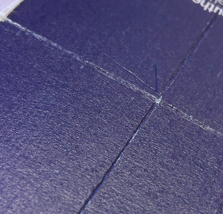
Cracking on printed paper showing a tear in the substrate .
The phenomenon of cracks or fractures that appear on the surface of printed board or paper. These cracks can appear if printed surface is scored or folded perpendicular to the grain direction. If a printed surface is folded or creased along the grain direction cracking most likely won’t be an issue.
Creasing
The creasing (scoring) of board using a roller or creasing method, enables it to be folded along a line.
Crop/cropping
Cropping involves the removal of unwanted areas of an image, resulting in only the required portion to be shown. This could be achieved within an appropriate software, which would be a permanent change to the image, or the image can be moved around within a smaller picture box, leaving only a portion visible. It is important to consider the resolution and integrity of the image quality when cropping.
Cut Flush
Cut flush or flush cut, is a binding method in which the covers are trimmed even (flush) with the book block. A guillotine or three-knife trimmer would be used for this method. It provides a very neat appearance but does reduce some protection of the book interior.
– D –
Die-cutting

A childrens board book using die cutting
A shaped cutting tool is used under force to cut a shape from the printing material e.g. a paper or board. Die-cutting is done after printing is complete using a stamping press.
Designers need to be cautious when designing a book that is to be die-cut. A simple rule is to avoid fine detail because if cuts are too narrow the substrate may not be able to withstand tearing.
Die-cutting is a great design technique for children’s board books.
Die stamping
Die stamping refers to a printing process in which the printing plates are etched with the required image then ‘indented’ onto the surface of the material. This can be done with or without ink, and is often referred to as an intaglio process.
Digital Press (DP)
A digital press is capable of receiving data to print directly onto paper or other materials without using printing plates. This type of press may utilise ink-jet or toner-based technologies.
Digital Printing
The use of ink- or toner-based technology on a digital press is referred to as digital printing. There is no need for printing plates as the data can be applied directly from a computer. Most of these technologies are CMYK-based.
Dot Gain
Dot gain is a condition where the spread of ink causes an increase in the dot size of an illustration or text. This causes the type to appear heavier and reduces clarity of images. It occurs on the printing press, with a variety of causes, some of which can be rectified with software. Uncoated stocks are more prone to dot gain than coated ones.
DPI (Dots Per Inch)
DPI refers to the output resolution of an imagesetter or printer. It refers to the physical ink dot density of an image, such as when it is printed onto paper. It will control how sharp your images will print and is different to PPI (Pixels Per Inch) which relates to the screen resolution of your image, rather than the printed result.
Dummy
The term dummy can be used to describe a blank sample copy of a book or document, particularly for large print-runs, which is prepared with the intended cover and paper materials for client approval. A dummy may also include all type and illustrations to show the positioning. Dummies are useful for the client to gain an indication of the bulk and binding style, as well as the general feel of the printed product.
Duotone
To create special toning, more accurate rendering, increased illusion of depth and detail, and sharper images, duotone involves the scanning of two plates of the same image. A darker colour (usually black) will be scanned as a high-contrast plate and another colour scanned as low-contrast. This is mainly used for black and white images.
– E –
Edition
An edition is a particular version of a publication. Further editions may be published for changes of content, design, or format.
Em
Em is equivalent to the space occupied by a capital M. The exact sizing will depend upon the typeface used and the width taken up will be twice that of an en space. Em spaces can be referred to as ‘muttons’.
Embossing (and debossing)
Sometimes termed blind embossing, it refers to the use of an block to raise (embossing) or recessing (debossing) an area on either a board or a paper that has already been printed. Two metal die-blocks are used – a raised ‘male’ and a recessed ‘female’ block.
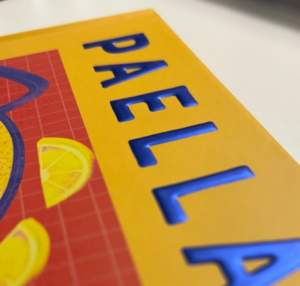
Embossed hard cover book
A stamp-press is commonly fitted with the blocks and the printed material run though with the blocks creating a 3D area.
Blind embossing is where the 3D effect does not line-up or register with any printed element e.g. a printed book title as contrasted with a printed background or image. For example a book title can simply be embossed (without the title being defined by print). This differs from where the embossing registers or lines up with a printed element.
See also Combination foiling
Endmatter
Endmatter refers to the content of the final pages of a book. This could include appendices, a glossary, a reference list, bibliography or endnotes in non-fiction publications. Fiction publication endmatter may consist of information about the author, advertising for other books by that author, or not be included at all.
Each endmatter element should begin on a new page and have typography consistent with the rest of the publication.
Endnotes
Endnotes contain information additional to the main text. They are best used when there are many notes, rather than only a few, and can be listed at the end of a chapter or organised by chapter as part of the book’s endmatter.
Endpapers
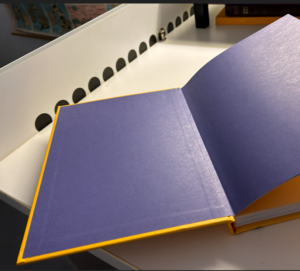
Colour special endpaper
Papers that line the interior of the cover (both front and back interiors) of a case bound book. Endpapers can be special coloured papers available from paper merchants, printed in a Pantone colour or printed with imagery (or as a solid colour) in CMYK.
Errata slip or Erratum
Where a corrigenda is a list of errors made by an author, an errata slip or erratum relates to errors introduced during production. A single error may be included as a separate piece of paper.
Extent
The extent is the total number of pages in a printed publication. For section sewn binding this number should be a multiple of four or eight. For perfect binding an odd number of pages is acceptable.
Extant
Extant is a term often seen in printer’s quotations presenting as a high level summary view of the book. It defines what already is known to exist, as described by the client, and contained in artwork files. It will define how the book will be produced without any input of the printer.
– F –
Flaps/French Flaps
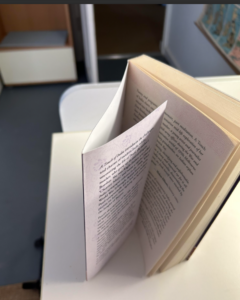
Paperback book cover with flaps of about four fifths cover size
Book cover flaps are the panels folded beyond the cover of a paperback or softcover book to the interior of the cover. They are often called French flaps or gatefolds.
Flaps can be full flaps – about the same dimension of the cover, 1/4, 1/2 or 2/3 flaps.
Flaps are a great vehicle for information and promotional material about the author, the book and the publishing company. They can contain author biography, endorsements or a summary of the book contents.
Functionally they can act as a bookmark and are seen as similar to a dust jacket giving the book a more premium feel..
Flexibinding (or Flexiback)
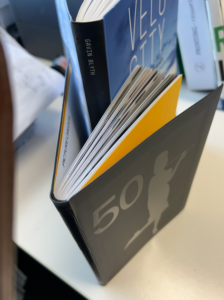
Stylish and versatile flexibinding
Flexibinding is a binding style often deployed for guides but also good for image rich books. Flexibinding is an in vogue alternative binding style to hardcase coffee table books – often smaller in dimensions to large format coffee table books. They are a great option for publishing photography or art, fashion, design, architecture etc. The spine of the book is rounded and the thin case flexible. While there a number of alternate supplier of materials for ‘fexibinding’, Flexibind is a registered trademark and a proprietary product.
Flush Cut
Flush cut or cut flush, is a binding method in which the covers are trimmed even (flush) with the book block. A guillotine or three-knife trimmer would be used for this method. It provides a very neat appearance but does reduce some protection of the book interior.
FOB
FOB stands for ‘Free On Board’ and relates to the customer’s responsibility for all freight costs, insurance, import and risks.
Foiling
Foil is a film with a metal or colour pigment applied to a printed page using a block. It is a non-ink based process applied after the printing has been completed. While other techniques to enhance the aesthetic of a book cover – metallic ink (either PMS or digital), metallic foiling has a metal look of authenticity.
Foiling is a process accomplished by a number of techniques:
Digital – Konica Minolta print machines have great digital foiling capability.
An add-on machine uses heat to stick foil to particular areas of toner (used in the printing process). No block is required meaning the process is quick and cost effective (for short print runs).
Cold Foiling – Uses an adhesive transferred by a plate to the previously printed surface. The foil is then applied to the adhesive. This process is only cost effective for very large print runs.
Hot Foiling (Hot Stamp Foiling) – A heated block is used to fuse the foil onto the substrate surface. The “stamp” element means there is also pressure applied to the substrate. A combination of this heat and pressure binds the foil to the book page/book cover. The pressure of the plate means there is an ever-so-slight indent (similar to the effect of debossing).
Combination Foiling – This is Hot Foil Stamping with an added female block above the substrate. This mean when the blocks are applied it produces a metallic foiled embossed area. The process happens simultaneously i.e. the foiling and embossing.
Four-colour inks
These are the standard pigmented inks used in the four-colour process. Also see CMYK.
Four-colour press
A four-colour press is a printing machine that can print four colours onto a single sheet in only one pass.
Four-colour process
The four-colour process is the standard method for colour printing. It involves layering the transparent inks cyan (C), magenta (M), yellow (Y) and black (K for key plate) in tiny dots to create the full spectrum of colour. The addition of a standardised colour bar to the printed sheets using the three primary colours and black. It enables the printer to assess the performance of the press by comparing the colour on the bar to that of the approved colour proof.
FPO
FPO stands for ‘For Position Only’. An FPO is a low-resolution image placed into a digital document to show the placement and size of the high-resolution image that will replace it.
Frontmatter
Frontmatter is the content at the beginning of a publication, prior to the main text. It can include matter such as the imprint, a table of contents, a title page, acknowledgements, a dedication, preface, and foreward. These pages are sometimes referred to as ‘prelims’.
– G –
GSM (Grams per Square Metre)
Related to paper used to print books, GSM measures the weight of the paper. While weight and paper thickness are related, GSM only defines the weight. That being the case many book designers and publishers commonly use GSM as a proxy or rough indication of the paper thickness. Weight and thickness of paper do not strictly correlate because some papers are more compact than others.
Grain direction
The direction in which all or most of the paper fibers are oriented in a paper sheet. Since the grain is produced on the forming wire of a papermaking machine in the direction of the web’s travel through the machine, the grain direction is also called the machine direction. The direction perpendicular to the grain direction is the cross-grain direction. Grain direction is an important factor of such paper properties as strength and dimensional stability.
Grain direction is very important in book printing. Grain direction in internal pages should run from top of page to bottom of page. This grain direction will allow the open book to be flatter. Grain direction of a paperback cover should be from left to right. This grain direction for the book cover, will help the book resist ‘curl’.
Prink Wiki – CC Licence – sharealike – second paragraph added
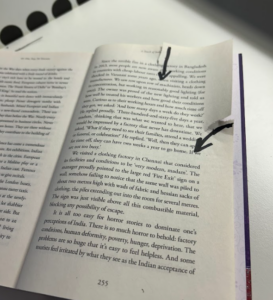
Test the grain direction by tearing from two directions
PUBLISHING TIP Grain direction is very hard to perceive. There is however an easy way to test if the page grain is correct. Simply tear the paper from the page edge. If the grain direction is top to bottom the tear will be quite straight. Tearing across the grain direction will produce a curved or crooked tear.
Grayscale
Using grayscale means working with only black and white, along with any halftones of grey. It is a measure to industry standard for printers.
Guillotine
A guillotine is a common machine in the printing and binding industries, used to trim board or paper before or after the printing process. A computerised machine can be programmed to perform a series of cuts.
Gutter
The area or margin of a book page that is close the the spine – on the Verso page (left page) this is to the right, On the Recto page (right page) this is closest to the left.
PUBLISHING TIP ‘Gutter Loss’ is a common problem for books that are adhesive bound – either perfect binding or bust bound. This especially applies to books that are glued with non PUR glue e.g. EVA glue. This is because the book will not sit flat (like PUR glued books or saddle-stitched documents. Gutter loss is particularly problematic when images are displayed across the gutter because part of the image – around 3-5mm on both the recto and verso pages – can disappear into the gutter. This can result in strange looking images across spreads. If the design demands an image across two facing pages, the designer can offset the image 3-5mm from the edge of the pages. Then when the document is open the image will smoothly transition or bridge across the spread.
– H –
Hardback or Hardcover
Either of these terms are generically used to describe a casebound book. It can include one- or three-piece formats, regardless of the method used for binding.
Hard Copy
A physical, printed publication of a book, as distinguished from an electronic file.
Half-bound
A book bound with the half-bound or three-piece style, utilises one material or colour on the spine and corners, with the remaining panels covered in a different, and sometimes cheaper, material. A combination of materials cloths and papers may be used.
Head and Tail Bands
Head and tail bands are decorative bands of plain or striped sewn cotton that are glued to the top and bottom of a casebound book’s paper spine during lining. They come in a wide range of patterns are colours and, while making little contribution to binding strength, do provide a pleasing aesthetic and are relatively inexpensive.
Hickey
A hickey or a bull’s-eye is an accidental printing defect normally caused by dust or lint. It can manifest as a white spot on a coloured background, or as a smudge.
Hot melt glue
Hot-melt glue needs to be heated and then cool. The process of cooling turns it into a solid. This glue is commonly called EVA and is an economical and fast way of book binding in contrast to a cold melt glue like PUR.
Hot stamping
Also known as foil blocking, is when a depression is imprinted on a book cover and a metallic foil is applied. Hot stamping is most commonly to lift the presence of a book title or a solid graphic e.g. a company brand, a publisher’s imprint or line artwork.
It is “hot” stamping because the process sues heat to adhere the foil to the substrate. Cold foil stamping uses adhesive.
Foils include gold, silver, copper, holographic and a range of solid colours. See a range of foils: Kurz website
PUBLISHING TIPS 1. Make sure the stamp is not too close to the book cover edges – there should be a 10mm safety area. 2. Hot foiling is best for larger blocks rather than fine detail spread across the cover. If stamping is needed for fine detail, and that detail is spread across the cover it is most cost effective to use cold foiling. Hot foiling needs the production of a stamp and the larger the stamp the more expensive the process will be. 3. Preparing artwork for hot foiling is similar to what is needed for other treatments e.g. spot colours, varnishes. The artwork should have a CMYK layer and a separate layer for whatever is to be stamped. The stamping layer can be artwork that shows the stamping area as a solid black.
Hyphenation and Justification
These terms relate to the determination of the accepted end of line breaks in justified typesetting. It is a system which adjusts spaces and breaks words to balance the text appearance and is most often software-generated.
– I –
Imprint
A printer’s imprint consists of the name and location of printing. This is often a legal requirement to comply with customs when printing overseas. It is distinct from the publisher’s imprint.
Ink-jet (printing)
The ink-jet method of printing utilises tiny droplets of coloured inks sprayed onto paper or other substrates to generate high-quality and detailed images. Photograph printing uses dye-based inks and durable documents are created using pigment inks.
Insert
A section of a book which is printed separately. An insert will often be printed on different paper to the rest of the interior and be bound between the existing signatures.
ISBN
International Standard Book Number (ISBN) used to identify a specific edition of a book – for newly published books it is a unique or book specific 13 digit serial number that can identify the book title, author and publisher.
An ISSN- ‘S’ standing for serial, is a similar unique number that identifies a magazine or journal.
– J –
Joints
In case bound books the hinges that enable the book to open easily and reducing stress on the binding. Joints are sometimes called French Joints.
– K –
Kerning
In typography the adjustment made to the space between the letters or individual characters in one or more lines of type.
– L –
Lamination
Lamination is a transparent film that can be applied to a variety of substrates. Lamination can be matt, satin, gloss or soft touch. Lamination enhances the aesthetic of a book but also acts as a protective layer. Lamination can be applied to paperback book covers (both sides) to prevent warping.
Lamination will change the way colours present because it absorbs light and reflects colour.
PUBLISHING TIP You can perform a test on how colours present by printing a digital sheet and then applying sticky tape tot he printout. Applying a shiny sticky tape next to a matt sticky tape will show the relative colour shifts.
Leading
Leading is also referred to as line spacing and refers to the vertical space between lines of type. It uses a point system and expressed as the following: 10pt, 12pt.
The term originated from the thin strips of metal that were used as spacing in the hot metal typesetting process.
Leaf
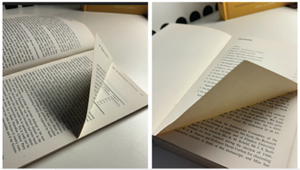
One leaf – 2 printed pages (left) and one printed page (right)
Leaf refers to a single sheet of paper within a book or publication. A leaf can be printed both sides i.e. one leaf can be two printed pages.
Limp Binding
Limp binding refers to a binding method in which the cover is made of a flexible material, such as leather or cloth. This method is often used for guide books and bibles.
Long Grain
The long grain in paper refers to the direction of the fibres running parallel to the longer dimension of the sheet.
Long grain printing in books results in less warping, a more stable spine and pages that turn easily. It is also the most economical way for paper to run through a printing press because of the way it affects the folding of the paper.
Lossless
Lossless is a method of data compression that avoids losing the original quality.
Lossy
This method of data compression results in a noticeable loss of quality. Lossy compression can be deployed when a file storage becomes restricted by file size.. For example an algorithm scans image files and reduces their size by discarding information considered less undetectable to the human eye.
– M –
Making
Making refers to a special order of paper. A making will usually be a non-standard or specific size and may involve a special weight or shade.
Manuscript
Manuscript is the term commonly used as the unpublished complete draft of a publication, as submitted to an editor or publisher by the author. Traditionally, it referred to hand-written material.
Mechanical Wood Pulp
The mechanical grinding of wood results in a pulp typically used in low-cost papers. If combined with chemical wood pulp, a higher quality paper will be produced.
Metallic Inks
Metallic inks contain very fine metallic particles, such as silver or gold, in place of regular inks.
– N –
Notch (burst) Binding
Notch, or burst, binding provides strong binding for coated pages without sewing. This method involves the gouging of grooves into the spine of the book block which allows for deeper penetration of adhesive. It can be used when perfect binding a book.
– O –
Offset
The most commonly used definition of offset in printing is as a lithographic method. Rather than printing directly from printing plate to paper or other material, the ink is first transferred to a rubber blanket. While this method has increased set up costs, the sharpness and colour are superior.
Opacity
Opacity in papermaking refers to the show through which is the paper’s relative ability to inhibit light transmission through the material. Low opacity will result in text and images on one side of the paper being visible from the other side.
Orphan
Orphan refers to very short lines of text that appear to dangle at the end of a page, without any additional lines from the same paragraph, leaving an excessive amount of white space. The term is often interchangeable with widow, referring to the same occurrence at the beginning of a page. There is no consistent standard across the industry to determine the correct usage.
Overs
Overs are the additional copies that exceed the agreed contract quantity. They are expressed as a percentage and are often chargeable, although negotiable.
– P –
Page-creep
See saddle-stitching
Pantone (PMS)
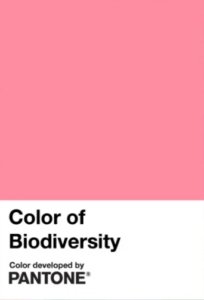
Pantone color ‘chip’. A color developed by Pantone based on ancient pigments found in sedimentary rocks of the Sahara desert
Pantone has developed a system for precision colour book reproduction. The Pantone Matching System (PMS) is a well known and widely adopted system that bridges the gap between publishing clients, designers and book printers to ensure expected colour requirements are met.
PDF stands for Portable Document Format. It is a technology from Adobe Systems that embeds images and fonts from other applications into a document that is easily viewed using the free Acrobat viewer or published on a web site. PDFs are generally of a lower resolution and file size, enabling them to be sent easily as email attachments, while still allowing layouts to be viewed.
Page
A page is a single side of a leaf of paper.
Papermaking
Papermaking is the craft and industry of producing the substrate or media for the printing of content both text and imagery. To say the invention in China and development of paper was historically significant is an understatement. Paper has underpinned world economic development exactly the same way electronic media and computer coding has provided a ‘container’ or medium for the transmission of information. For thousands of years paper was the primary transmitter of information, slowly replaced today and in recent history, by electronic transmission across television, radio, tape and internet.
The world centres of papermaking roughly align to the availability of wood pulp, electricity and water and industrial capability. They are in order of importance:
-
China – The world’s largest paper and paperboard producer.
-
United States – Major producer, especially in packaging and pulp.
-
Japan – Known for both high-tech paper and traditional washi.
-
Germany – Leading producer in Europe.
-
Finland & Sweden – Global leaders in pulp, specialty papers, and sustainable forestry.
-
Canada – Major pulp and newsprint producer.
Understanding paper is only really necessary for high end designers and print specialists. But the editors of the Encyclopaedia of Book Printing thought it too fundamental to ignore.
The process: Wood is turned into paper. An important stage is if the lignin in wood is extracted. Lignin is like a glue that holds wood fibres together. Chemicals can dissolve the lignin freeing cellulose, the key ingredient in high-end papermaking for book printing. The ‘kraft’ process uses chemicals to dissolve the glue-like lignin freeing the cellulose.
Paper that has not had the lignin removed might be called groundwood, bulky paperback or newsprint. It’s cheap and is used by publishing companies producing cheap books from their backlist. But sometimes its used for poetry and artbooks – its got a grungy, earthy natural feel.
Paper made from refined cellulose fibres – chemically refined paper – has sophistication, is smooth offering better colour reproduction and a quality feel.
Perfect Binding
Perfect binding is an adhesive binding that brings all sections together and binds them to the cover with glue. This method does not use saddle-stitching, wire-o-binding, or sewing.
Proof
A proof is a sample representation of a final printed product. It may be supplied in electronic form at an earlier stage, or in printed form that will show the publication as it will be printed. This allows for colour correction of elements like images. The electronic form of proofing can be a PDF file. The printed form of proofing can be either:
- Digital – produced by inkjet or toner based technologies printed on digital press paper that might differ from the actual paper being used in an offset print run.
- Offset – produced by plates and printed on the same paper as being used for the whole print process. These are sometimes called ‘wet proofs’ because they use liquid ink.
Proofs are commonly printed on proofing sheets containing several pages of the book – not necessarily consecutive pages – printed on the one sheet side by side. A typical proofing sheet might contain up to 8 pages. The larger the book size the fewer pages can be printed on the proofing sheet. Publishers can specify which pages to include on the proof sheet e.g. page 6, page 12, page 104 etc.
Digital proof sheets are fast and cheap. Offset proofs are expensive and take more time to produce sometimes adding hundreds of dollars and weeks to the production process.
PUR
PUR is a cold-melt binding glue. It allows for a flat layout without cracking due to its flexibility.
– Q –
Quarter bound
Where the material used on the spine of the book wraps around to cover a part of both the front and back covers. Used on case-bound books.
– R –
Register or Registration

Example of registration mark
In full colour offset printing the paper sheet needs to pass through four print stations to apply 1. cyan, 2. magenta, 3. yellow and 4. black ink. The impressions of the four different colours needs to be in exact alignment. Printers use the registration marks positioned at each corner of the impression, to be in exact alignment with each other.
PUBLISHING TIP Export artwork in PDF format with registration marks
Rigidity
In book production, rigidity of board refers to how stiff, strong, and resistant to bending the board is—especially important for hardcover and case-bound books.
Board rigidity is determined by:
Board type
- Greyboard / Chipboard is the most common board used for for hardcover cases. It ha good rigidity at relatively low cost. It is made from recycled fibres
- Binder’s board is a higher quality greyboard that is more uniform in density producing better stiffness and cleaner edge
- Thickness (caliper)
Rigidity increases exponentially with thickness. Even a 0.5 mm increase makes a noticeable difference.
Common book boards:
- 1.5 mm – light hardback, children’s books
- 2.0 mm – standard hardcover (most common)
- 2.5–3.0 mm – art books, albums, deluxe editions
Basis weight & density
- Higher gsm is a usually stiffer cover
- Dense, well-compressed fibres resist bending better
- Poor-quality recycled board can be thick but still feel “soft”
- This is why two 2 mm boards can feel very different.
Grain direction
- Board bends more easily across the grain
- For covers, grain should run parallel to the spine
- Wrong grain orientation reduces perceived rigidity and causes warping
Moisture content
- Environmental control during casing-in matters a lot and because most economic hard case printing is best done in Asia, a factory that has well established environmental control is important.
- High humidity leads to a softer, more flexible board
- Low humidity leads to stiffer book cover but can become brittle
Why rigidity matters in books
- Prevents warping and corner damage
- Improves shelf presence
- Protects text block – the interior of the book
- Affects how “premium” the book feels in hand
- If the book is too rigid the book may not open well. But if the book is not rigid the cover can warp and the corners can crush
Fox Merit’s recommendations
| Book type | Recommended board |
| Standard hardcover novel | 2.0 mm binder’s board |
| Art / coffee-table book | 2.5–3.0 mm binder’s board |
| Children’s board book | 1.5–2.0 mm laminated greyboard |
Recto
The right-hand pages of an open book are the recto pages and left-hand the verso pages.
Rounded Corners
Often used in childrens board books, rounded corners are produced as a part of the process of trimming and binding. Printers use a cutting die prior to or during the binding process.
– S –
Saddle-Stitching
Otherwise known as wire-stitching, this method uses a continuous wire to shoot and form staples into the exact centre of the book spread. It is commonly used for childrens books enabling the book to sit flat when opened enhancing usability for very young children. Many digital presses are setup with inline saddle-stitching capability. Saddle-stitching produces a v-shaped spine that cannot be used to contain the book title/author name.
While saddle-stitching is a cost effective way of book binding it is limited to books with pages below 80 printed pages i.e. 40 leaves depending on the thickness of the paper. Additionally saddle-stitched books can be affected by page-creep – the situation where pages incrementally creep out beyond the edge. The 4 centre printed pages demonstrate the most page-creep. Or put another way the inner inner pages experience more creep than the outer pages.

Page-creep in a saddle-stitched book (exaggerated)
PUBLISHING TIP ‘Page-creep’ is a common problem for books that are saddle-stitched especially for books with more than 70 printed pages. In a small book the amount of page-creep is negligible often going unnoticed. In page-creep the inner pages experience more creep than the outer pages resulting in content on pages closer to the center of the booklet needing to be positioned inward to a greater degree (than the outer pages). The solution to page-creep on higher page-count books, is ultimately in the hands of the designer – simply do not position elements close to the edge of the pages. And this applies more to the pages closer to the centre of the book.
Score
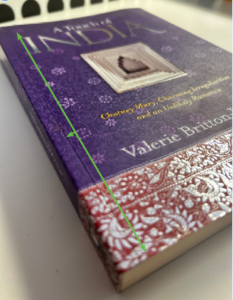
Green arrows in Image shows score on book cover
Scoring (creasing) is when a board is subject to a roller or creasing method. The roller produces a fold/indentation along a line adjacent to the spine on both sides of the spine. Covers can be scored to increase book durability in particular to reduce stress on the glue bind.
Scoring is particularly important for PUR glue (rather than less strong EVA glue). Because of the strength of PUR glue, opening a PUR cover transfers all stresses to the hinge not the glue.
This process will also reduce cracking of laminated covers and also the layer of ink – fracture lines. If cracking occurs, the substrate colour will show through the cracks which can be particularly unsightly for covers printed with dark ink.
Self-Cover
The interior paper of the book is identical to the cover. All the pages of the book a identical in weight and dimension.
Short Grain
The short grain of paper is where the fibres run parallel to the shorter dimension of the sheet.
Signature
A section of the book usually comprised of a folded printed sheets trimmed to the book size. Also referred to as Sections.
Smyth Sewing
Smyth sewing, also known as section sewing, involves each section/signature being sewn to the others through the fold rather than from the side. This method has the advantage of the finished book being able to be laid flat.
Spine shape
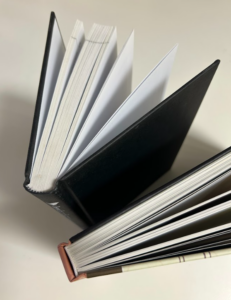
Round and square spined casebound books
Casebound books can have different spine shapes including square and rounded (and a variety of derivates). A square spine is ideal for books needing a modern contemporary feel – books have crisp edges. Rounded spines have a more durable library feel and allow larger open books to sit flatter.
Spiral Binding
When spiral binding, pages are first punched with small holes, allowing the insertion of a coiled wire. The spiral wire can vary in diameter and be covered in coloured plastic. This method allows the publication to lay very flat when opened.
Spot Colour
Spot colour printing uses specific colours of ink (usually premixed and solid) to produce very consistent, vibrant, and exact matches. These are very important for branding, logos, and designs requiring very precise hues. Each of the spot colours needs its own ink and printing plate in offset printing. This can lead to a higher expense than CMYK printing.
Spot Varnish
Spot varnishing involves the application of a matte or gloss varnish to a particular area of the page or cover. It can be a pressed using an in-line method, or as a separate pass.
Spot UV coating
A clear high-gloss finish applied to a a spot/location on a printed surface and dried instantly by ultraviolet light. Spot UV can be applied over a matt laminated book cover for a premium effect. Its highly glossy appearances creates a wet-look.
Spot UV coating is different to varnish in that it is more expensive, thicker and glossier, and is dried instantly by UV light.
Sprayed edges/edge staining
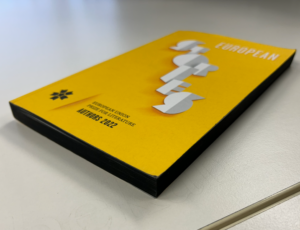 A type of edge treatment involving application of a dye or other colorant to the trimmed edges of a book. Edge staining may be performed on all three unbound edges, only on the side edge, or only on the top edge. In the latter case, the process is known as top staining. Edge stains added in an irregular or spatter pattern are known as sprinkled edges.
Prink Wiki – CC Licence – sharealike
This treatment is also called edge decoration.
Edges can be decorated with gold or silver foil or as an ink aerosol spray.
Spread
Two facing pages of a book. Spreads are ideally in the centre of a signature to avoid registration issues i.e. the image is wholly printed across a single sheet.
– T –
Trim
Trim area is related to the final process of a printed book. After the book pages are bound to the book cover (for a paperback book) the book is trimmed on 3 sides to exactly the required size. It is the finished or completed size of the book.
PUBLISHING TIP Authors need to ask questions about what size their book should be. Book design isn’t about designing ‘flat’ cover artwork that might appear online e.g. as a ’tile’ on Amazon. Book design is akin to packaging design in that the height width and depth of the book should be considered. A skilled book designer thinks in 3D – three dimensions. If the spine is too thin the book might look underweight or insubstantial. If the page count is small, a smaller book size may give the book more bulk. For the very best result you should know it is part of the book designer’s job to recommend the books dimensions and it is best left in their hands as a single integrated design exercise exercise.
Here are some Fox Merit book examples with ideas or suggestions for trim sizes:
| Book type | Page count | Trim size | Dimensions |
|---|---|---|---|
| Poetry | 200 | A5 | 210mm x 148mm |
| Novel | 200 | 5″ x 8″ | 203mm x 127mm |
| Novel | 300+ | 6″ x 9″ | 229mm x 152mm |
| Trade Paperback | 250 | 6″ x 9″ | 229mm x 152mm |
| Memoir | 300+ | 6″ x 9″ | 229mm x 152mm |
| Manuals and Workbooks | 275 | 8″ x 10″ | 254mm x 203mm |
| Manuals and Workbooks | 350+ | A4 | 297mm x 210mm |
| General Non-Fiction | 300 | 6″ x 9″ | 229mm x 152mm |
| Non-Fiction Pocket Books | 100 | 4.37″ x 7″ | 178mm x 111mm |
| Photography or Art Books | 400 | No common sizes | |
– U –
Um
Um is a measurement of the thickness of paper usually determined by a micrometer and expressed in microns. One micron is the equivalent of 1/1000 of a millimetre.
PUBLISHING TIP Often book designers and publishers confuse ums and GSM. GSM is not a measure of thickness but of paper weight. Due to differences in compaction, the same GSM paper can be thicker of thinner. While GSM is not a measure of thickness it is a good proxy measure. Designers should confirm spine width in mm with the printer especially for a paperback book.
Unbacked
A sheet that has been printed on only one side is referred to as unbacked.
Uncoated
Uncoated paper is more absorbent, textured, and porous because it has no chemical coating. Standard printer paper, notepads, and books are examples of uncoated paper.
– V –
Variable Data Printing
As the name suggest, variable data printing involves each digitally printed piece varying from those before and after it. The variation may be as text, images or data, direct from a database, and can be used for tailoring designs, messages, and offers targeted to multiple recipients individually.
Varnish
A varnish is an embellishment that’s purpose is a protective thin coating to reduce ink smudging or rub-off. It is applied as a liquid in either matt, satin or gloss. It can also be decorative. Varnishes can be flood coating (covering the whole page) or spot coating (applied to a section)for visual effect.
Varnish is different to spot UV coating in that it is more expensive, thicker and glossier than varnish and is dried instantly by UV light.
Vellum
Vellum is a binding material traditionally made from the inner side of calfskin. Today, the same term may also be used in reference to a strong, creamy paper. It is a very high-quality material known for its smoothness and durability. Vellum often possesses a translucent quality and is mainly used for limited edition and presentation fine books.
Verso
The left-hand pages of an open book are the verso pages and right-hand the recto pages.
Visable thread
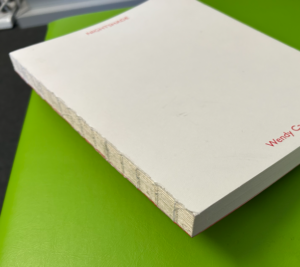
Exposed or visible thread section sewn binding
This binding finishing is also known as an exposed spine. It is a niche binding style adopted by those producing books like artbooks and poetry. It has a rustic yet sophisticated feel. Sewn sections are themselves sewn together to form a sewn block. The cover can be included in the sewing as a sort of heavy signature. Or the cover can be manually glued to the first and last pages.
– W –
Wet proof
See Proofs
Widow
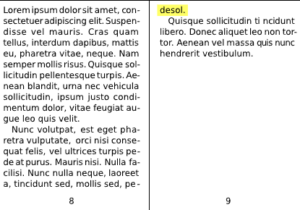
A widow appears alone at the top of a typeset book page.
Widow refers to very short lines of text that appear to dangle at the beginning of a page, without any additional lines from the same paragraph, leaving an excessive amount of white space. The term is often interchangeable with orphan, referring to the same occurrence at the end of a page. There is no consistent standard across the industry to determine the correct usage.
Wiro (Wir-o) binding
A book binding method for publications like training manuals, cookbooks and reference documents where the book block is punctuated with a series of rectangular holes and a double wire coil is threaded through the holes.
– X –
X-height
In typography the part of a letter that has no ascender e.g. the upper part of a ‘d’, and no descender e.g. the lower part of a ‘g’. In typefaces/font families the x-height can be short and squat or can be high.
A typeface with a low x-height is often seen as more elegant, more refined and more readable. Low x-height type is seen to be more readable because the long ascenders and descenders create more recognisable word shapes or silhouettes. These typefaces are often used in novels.
XML
XML or Extensible Markup Language is data used to identify the properties of different text elements in an electronic file used to produce a typeset book. XML is ‘extensible’ because it provides the syntax (logic) but allows users to define their own parameters/elements in a way that suits their needs. Extensibility can also be thought of as stretchable or flexible.
XML is often used to publish data across platforms e.g. printed book and/or a web page.
– Z –
Zero Make-Ready Press
A zero make-ready press has the capability for a second printing plate to made ready while the first is printing. This enables the second unit to commence printing as soon as the active one is complete. This type of press is web-fed.

Australia’s book design and pre-press experts.
Do you need help setting your book artwork up for print?
Does book printing seem too complicated?
Are you
- an author who has asked a graphic designer to produce artwork for a book and they don’t seem to know how to do it; or
- a graphic designer who has been asked by an author to arrange printing of a book
and it seems confusing? Help is at hand. Our trusted design and pre-press associates can make sure the book is expertly prepared for printing. This can include specifications like bleed, spine width, image resolution, spot colour, varnishes, foils, gutter width, print methods (digital or offset), paper choice and digital. Childrens board book set-up can be especially tricky.
Green Hill’s service starts at just $175 – a small price to pay for piece of mind regarding you board book printing project. If it’s a small issue, remediating your files for print will be free! See more details: Artwork triage
Green Hill’s service starts at just $175 – a small price to pay for piece of mind regarding you board book printing project. If it’s a small issue, remediating your files for print will be free!
Call the Green Hill help-line on
1300 810 131