
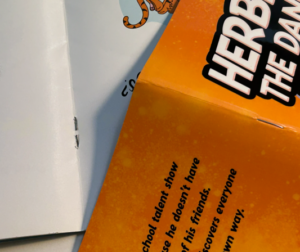
Saddle stitch – interior and exterior views
Otherwise known as wire-stitching, this method uses a continuous wire to shoot and form staples into the exact centre of the book spread. It is commonly used for childrens books enabling the book to sit flat when opened enhancing usability for very young children. Many digital presses are setup with inline saddle-stitching capability. Saddle-stitching produces a v-shaped spine that cannot be used to contain the book title/author name.
While saddle-stitching is a cost effective way of book binding it is limited to books with pages below 40 printed pages i.e 20 leaves depending on the thickness of the paper. Additionally saddle-stitched books can be affected by page-creep – the situation where pages incrementally creep out beyond the edge. The 4 centre printed pages demonstrate the most page-creep. Or put another way the inner inner pages experience more creep than the outer pages.

Page-creep in a saddle-stitched book (exaggerated)
PUBLISHING TIP ‘Page-creep’ is a common problem for books that are saddle-stitched especially for books with more than 70 printed pages. In a small book the amount of page-creep is negligible often going unnoticed. In page-creep the inner pages experience more creep than the outer pages resulting in content on pages closer to the center of the booklet needing to be positioned inward to a greater degree (than the outer pages). The solution to page-creep on higher page-count books, is ultimately in the hands of the designer – simply do not position elements close to the edge of the pages. And this applies more to the pages closer to the centre of the book.
« Back to Glossary Index