
Print your book – Darwin
Find the best print solution for your book
Find the best print solution for your book printing project
 Estimated reading time: 15 minutes
You might be an indie author, an experienced writer, a content developer, a thought leader or a corporate communications manager. No matter what category best describes you, when it comes to publishing and printing a book there is a mountain of complex and difficult terrain to navigate.
 Possibly the worst thing you can do is to wander into your local printer that you pass on your daily commute. That’s because this local printer in or around Darwin, might be a general printer (without book printing skills and equipment) or a highly specialised printer. The general printer likely won’t have the technology to do the job well and at a good price, the specialist printer might specialise in something other than book printing.
Great books are a combination of great content, great design and great print. Great print is a solution that matches your publishing objectives, with the quality you need, with price.
Plan your book print project
 This being the case you need a plan, so these resources are used wisely. To produce a book you should adopt project management techniques, develop a project plan and use that as your guide. You don't want people scrambling around, money draining out and time slipping by.
Start at the end
Sometimes it pays to work backwards. In planning, you might like to start with what the book might sell for and then determine what cost the book needs to print at - not an exact figure but a 'best guess'. The graphic below is orthodox thinking about how to proceed with a book publishing project - design first, print and then price for sale.
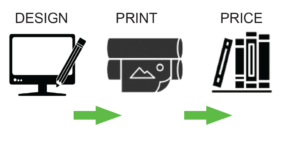 But you shouldn't finalise the design of a book before you have a grasp on what the book might cost to print. This is so design work does not need to be revised and the print budget can be met. And design elements also impact print timelines. For example if your designer recommends gold foil, a cloth cover and scattered pages in the book that fold out beyond the cover, expect a larger print bill and longer production time. This book might only be printed economically in Asia, so your timeline to market will be extended. At very least the designer needs to work within the restraints of your approximate print budget and your timeline.
Let price drive design
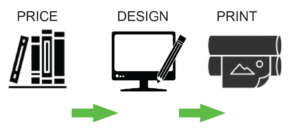 You might like to consider a different model. Work out your objectives (financial or otherwise), determine your budget, get print advice, only then brief your designer. This approach looks like the one shown in the diagram. Price means what you might sell the book for or what a reader will pay. The financial equation is shown in the table below.
| Description | Per Book |
|---|---|
| Sale price – what readers will buy the book for | $49.99 |
| Wholesale price – what a book store will pay | $20.00 |
| Print cost | $10.00 |
| Profit | $19.99 |
If you want to make a profit of $19.99 per book you need to print for $10. This means the book designer will have to design with meeting that print price in focus.
Determine your book specifications
Because it is best to design a book to fit within a print budget, an author or publisher will need to understand about the print options available.
Here's a powerful key. Good design will always win out over elaborate print treatments. A designer who wants a book filled with special treatments may be a lazy designer using those special treatments to impress and, to prop up an average design. These special treatments, often termed embellishments, might include metallic foiling, metallic inks, varnishes, die-cuts, gatefolds, edge treatments, embossing and expensive papers. A good rule of thumb is to limit special treatments to no more than 4. For a comprehensive list of embellishments see: embellishments
Basic list of characteristics/specifications
Here is a list with the mandatory basics - you will need to decide on and document.
Book specifications example
Design the book
Design is a critical part of the publishing process. Good design will trump fancy print. However it's clear that a print embellishment here and there can also make a real difference and the skilful use of different types of paper is great.
Are graphic designers book designers? No, but they can be. Are book designers graphic designers? Yes, always. They have graphic design skills and add an understanding of the nuances and challenges of book design. A good book designer will be able to recommend papers and treatments along with ink and binding options.. In actuality these are creative components of the book, influencing the look and feel of the final product..
Start the design process by briefing the book designer. This entails instructing the designer in a range of needs and parameters. Knowing the limitations of the print budget is important information.
Often good design is achieved through 'open brief' instructions to the designer that are quite broad. The last thing you want to do is to be heavily prescriptive, so prescriptive that the book designers aesthetic sensibility or creative prowess is squashed.
Print your book
When everything is ready you can opt to do it yourself by working directly with the printer or passing the responsibility to a print arranger like Fox Merit.
Find a book printing solution
Please fill in the form and submit.

Australia's book design and pre-press experts.
Do you need help setting your book artwork up for print?
Does book printing seem too complicated?
Are you
- an author who has asked a graphic designer to produce artwork for a book and they don't seem to know how to do it;
- a graphic designer who has been asked by an author to arrange printing of a book
Does it all seem confusing? Help is at hand. Our trusted design and pre-press associates can make sure the book is expertly prepared for printing. This can include specifications like bleed, spine width, image resolution, spot colour, varnishes, foils, gutter width, print methods (digital or offset), paper choice and digital. Childrens board book set-up can be especially tricky.
Green Hill's service starts at just $175 - a small price to pay for piece of mind regarding you book printing project. If it's a small issue, remediating your files for print with Fox Merit will be free! See more details: Artwork triage
Call the Green Hill help-line on
1300 810 131
greenhillpublishing.com.au